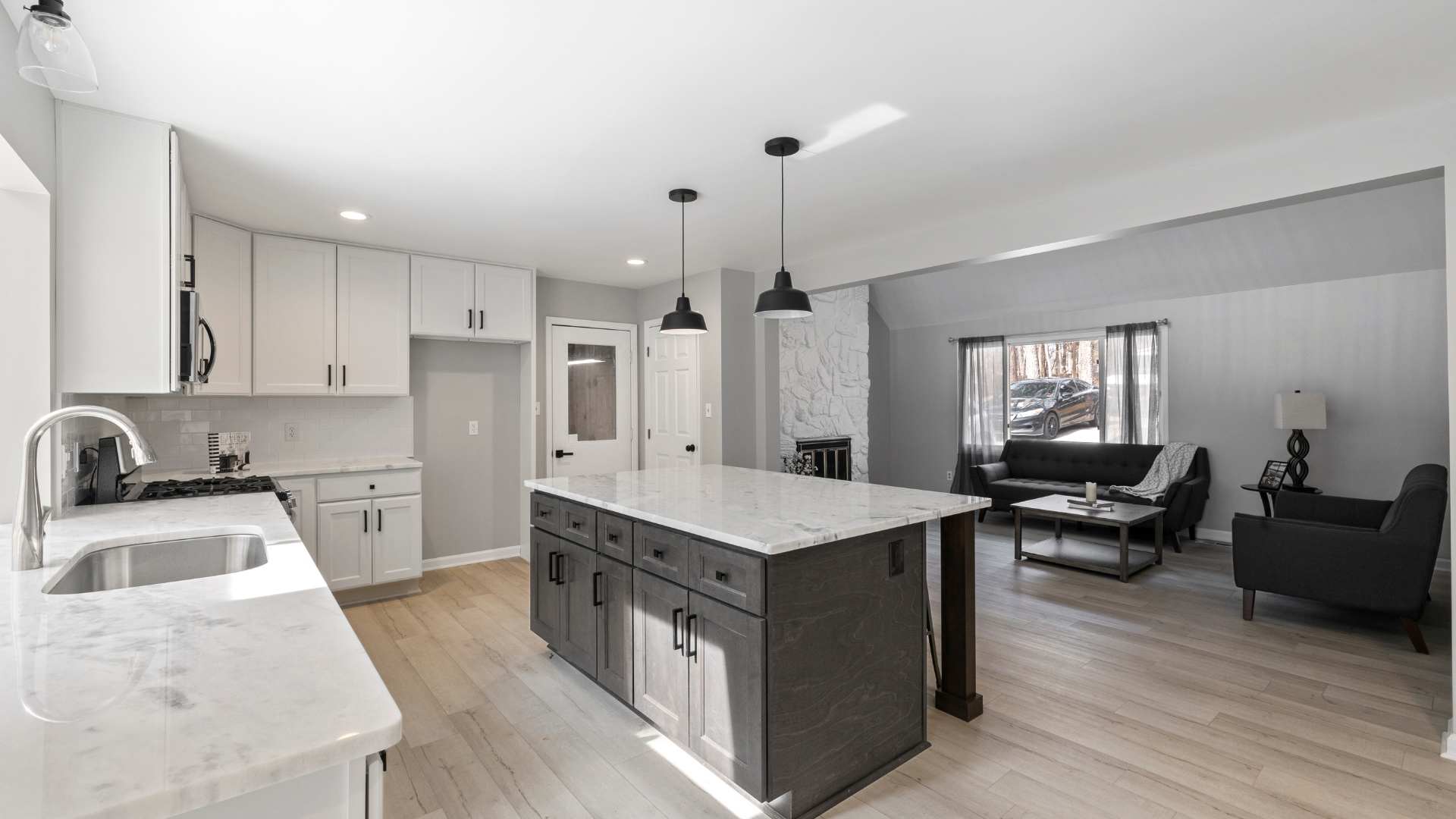

Sustainable home renovation is one of the most marketed and least honestly explained topics in the home improvement industry. Products get labelled “natural,” “green,” and “sustainable” without any certification or data behind the claim. Homeowners trying to make better choices get sold on aesthetics and feeling rather than measurable environmental impact.
This guide cuts through that. It covers which eco renovation decisions actually reduce resource use or emissions, which certifications carry real weight, which Ontario rebate programs exist right now, and what to skip because the environmental impact is negligible. The angle here is honest. Not every green choice has equal impact, and treating you like an adult means saying so.
If you’re planning a kitchen renovation alongside your eco goals, the Complete Kitchen Renovation Guide is the starting point for understanding project scope before layering in sustainability decisions.

Key Takeaways
- Eco-friendly renovation decisions with real impact: ENERGY STAR appliances, WaterSense fixtures, improved insulation when walls are open, and low-VOC materials in an enclosed renovation space.
- Certifications that carry weight: FSC (wood), GreenGuard (VOC content), WaterSense (plumbing), ENERGY STAR (appliances and windows).
- Greenwashing is common. “Natural,” “green,” and “sustainable” without third-party certification mean nothing verifiable.
- The Home Renovation Savings program (Enbridge Gas and Save on Energy) is the current active rebate program in Ontario, replacing the now-closed Canada Greener Homes Grant.
- Not all eco choices have equal impact. Be selective about where you invest time and money for environmental benefit.
- Deconstruction over demolition recovers usable materials and reduces landfill. It is worth asking your contractor about specifically.
Jump to a Section
What Eco-Friendly Renovation Actually Means
An eco-friendly renovation reduces one or more of the following in a measurable way: energy consumption, water consumption, indoor air pollutants, waste sent to landfill, or the embodied carbon in materials. That’s the operational definition. Everything else is either marketing or a rounding error.
Some eco-friendly renovation decisions make a large, measurable difference. Replacing a standard toilet with a WaterSense model saves tens of thousands of litres of water per year. Installing ENERGY STAR appliances reduces household electricity use by 10 to 20 percent. Adding insulation to open walls improves your home’s thermal envelope at a fraction of the standalone cost.
Other decisions marketed as eco-friendly renovation choices have minimal verifiable impact. Choosing a grout with a vaguely green marketing claim over an identical product without one does not meaningfully change your renovation’s environmental footprint. This guide focuses on the decisions that actually move the needle.
Certifications That Carry Real Weight in an Eco-Friendly Renovation
Third-party certification is the difference between a verified claim and marketing language. Here are the four certifications worth looking for when planning a sustainable renovation.
FSC
Forest Stewardship Council
Applies to wood and wood-based products. FSC certification means the wood was harvested from forests managed for environmental and social standards. Look for it on cabinet boxes, solid wood components, and plywood. Not all FSC claims on finished products reflect the full chain of custody, so look for FSC-certified specifically on the product, not just the company.
GreenGuard
VOC content in paints, adhesives, materials
GreenGuard and GreenGuard Gold certification verify that a product meets strict limits on volatile organic compound (VOC) emissions. This matters in a renovation because adhesives, primers, paints, and grout sealers all off-gas in an enclosed space. In a kitchen or bathroom renovation with limited ventilation, low-VOC products are a practical health and safety choice alongside an environmental one.
WaterSense
Plumbing fixtures and faucets
WaterSense is an EPA certification program for water-efficient plumbing products. WaterSense-certified toilets use 4.8 litres per flush or less, compared to 6 litres for standard models and 13 litres for older pre-1994 fixtures. WaterSense-certified faucets and showerheads use at least 20% less water than standard models. This is a certifiable, measurable benefit with direct utility bill savings.
ENERGY STAR
Appliances, windows, heating and cooling
ENERGY STAR is a Canadian and US government-backed certification that sets minimum efficiency standards for appliances, lighting, windows, and HVAC equipment. It is the most directly useful certification in an eco-friendly renovation because it applies to the appliances and mechanical systems that consume the most energy in a typical household over their lifetime.
Greenwashing: What It Looks Like and How to Spot It
Greenwashing is the practice of marketing a product as environmentally responsible without substantive evidence to support the claim. It is extremely common in renovation materials, particularly in the flooring, cabinetry, and paint markets. Calling it out is part of treating homeowners honestly.
Common Greenwashing Claims to Question
- “Natural” – means nothing without specifics. Many highly toxic substances are natural.
- “Green” or “eco” – without certification, this is a colour and a feeling.
- “Sustainable” – ask what standard defines sustainability for this product.
- “Non-toxic” – not a regulated term. Ask for VOC data or GreenGuard certification.
- “Environmentally friendly” – requires proof. What does the product replace and by how much?
What to Ask Instead
- What third-party certification does this product carry?
- What is the VOC content, and is there a test report?
- What is the FSC certification status of this wood product?
- What is the WaterSense flow rating for this fixture?
- What is the ENERGY STAR rating for this appliance?
Worth Knowing
A product without certification is not automatically worse than a certified one. Certification costs money and some smaller manufacturers with genuinely good products don’t pursue it. But absent certification, you are relying on the manufacturer’s word. In a renovation where you have limited ability to verify claims once materials are installed, third-party verification is worth requiring.
Eco-Friendly Renovation Materials: What to Look For
This section covers materials relevant to kitchen and bathroom renovations. For detailed product-level comparisons, see the Kitchen and Bathroom Materials Overview Guide.
Low-VOC Paints, Primers, and Adhesives
VOCs, volatile organic compounds, are chemicals that off-gas from paints, adhesives, grout sealers, and primers – particularly in an enclosed space during and after renovation. In a bathroom or kitchen with limited airflow, the concentration can be meaningfully higher than in an open room.
Low-VOC and zero-VOC paints are widely available at standard price points and perform identically to conventional paints in most applications. There is no quality trade-off. GreenGuard-certified paints meet verifiable VOC limits. Tile adhesives and grout sealers are more varied – check the GreenGuard database before specifying products for an enclosed space.
Low-VOC materials in a renovation also connect directly to indoor air quality after the renovation is complete. This is covered in more detail in the Mould, Moisture and Safety Prevention Guide, which addresses ventilation and chemical off-gassing during and after renovation.
Sustainable Cabinet Materials in an Eco-Friendly Renovation
Cabinet boxes in most standard renovation cabinetry are made from particleboard or MDF. Both are wood composite materials that use adhesives which can off-gas formaldehyde. FSC-certified solid wood or plywood, and formaldehyde-free MDF where composite material is used, are the higher-standard sustainable choices for cabinetry.
Cabinet door and box materials are covered in depth in the Kitchen and Bathroom Materials Overview Guide. The relevant question to ask when specifying cabinetry for an eco-friendly renovation is: does the cabinet box carry FSC certification or a formaldehyde-free certification, and what is the adhesive used in the box construction?
Reclaimed Materials: Where They Work and Where to Be Careful
Reclaimed materials – salvaged wood, reclaimed tile, vintage fixtures – have genuine eco-friendly renovation value because they avoid new resource extraction and often have embodied durability that new materials don’t. A piece of old-growth reclaimed wood is denser and more dimensionally stable than most new lumber.
But reclaimed materials need evaluation before use in kitchens and bathrooms specifically:
- Reclaimed wood in wet areas: Reclaimed wood used in a shower area or as a vanity top requires careful assessment of its previous exposure history and proper sealing. It can work beautifully but is not a straightforward swap for purpose-built wet-area materials.
- Reclaimed tile: Dimensional consistency matters for installation. Reclaimed tile varies in thickness and flatness, which affects the substrate levelling and installation. Work with an experienced tile installer if using reclaimed tile in a kitchen or bathroom.
- Reclaimed fixtures: Old faucets and toilets may contain lead solder or pre-1994 water-inefficient flush mechanisms. Evaluate before installing. Vintage fixtures with modern internals can be a good middle ground.
Countertop Materials with Lower Environmental Footprint
Recycled glass countertops are made from post-consumer recycled glass in a cement or resin binder. Paper composite countertops use recycled paper with a resin and have a low embodied carbon profile. Locally quarried stone has a lower transportation footprint than stone quarried overseas, though the quarrying process itself has significant environmental impact regardless of origin. Quartz countertops use significant resin (polymer) binders. Laminate has a low embodied carbon profile but uses plastics and resins. None of these is a clear winner on all environmental metrics. The most practical sustainable choice for countertops is usually the most durable one, because longevity reduces lifecycle impact regardless of material origin.
Water Efficiency: High-Impact Eco-Friendly Renovation Decisions
Water efficiency is where eco-friendly renovation decisions have some of the clearest, most measurable impact. The numbers are specific and the savings are real.
WaterSense Toilets: The Numbers
A standard toilet uses 6 litres per flush. A WaterSense-certified high-efficiency toilet uses 4.8 litres or less. In a household flushing an average of five times per day per person, a family of four saves roughly 4,380 litres of water per year by switching from standard to WaterSense. That is a meaningful, verifiable number.
Older toilets pre-dating 1994 use up to 13 litres per flush. Replacing one with a WaterSense model saves over 29,000 litres per year for a family of four. If your bathroom renovation involves an older toilet, replacing it is one of the highest-impact eco-friendly renovation decisions available at any budget.
Dual-flush toilets offer a half-flush option for liquid waste, typically around 3 litres, and a full flush for solid waste. They are widely available, WaterSense-certified at most models, and are now a standard specification in mid-range and upper-range bathroom renovations across the GTA.
Low-Flow Faucets and Showerheads: GPM Ratings Matter
Flow rate is measured in gallons per minute (GPM) or litres per minute (LPM). Standard showerheads flow at 2.5 GPM. WaterSense-certified showerheads flow at 2.0 GPM or less. That 20% reduction in flow rate translates to roughly 10 fewer litres of water per 5-minute shower.
It is worth addressing the common concern directly: low-flow showerheads do not have to feel weak. This was a real issue with first-generation low-flow products. Modern showerheads achieve lower flow rates through air entrainment and pressure-compensating technology that maintains a satisfying spray pattern at reduced water volume. The quality of the product determines the experience. A cheap low-flow showerhead often feels weak. A quality-specified low-flow showerhead at 1.75 GPM can feel better than a standard 2.5 GPM unit.
For kitchen faucets, WaterSense-certified models flow at 1.5 GPM at the kitchen sink versus the standard 2.2 GPM. Over a year of daily use, this difference adds up to thousands of litres saved.
Tankless On-Demand Water Heaters
A conventional tank water heater keeps a full tank of water hot all day, every day, whether you use it or not. That standby heat loss represents a consistent energy draw. A tankless (on-demand) water heater heats water only when it is needed, eliminating standby loss entirely.
The sustainability and financial trade-off looks like this:
Advantages of Tankless
- Eliminates standby heat loss
- Can reduce water heating energy use by 24 to 34% in homes that use under 41 gallons per day
- Longer lifespan than tank models (20+ years vs 10-15 years)
- No risk of tank failure and water damage
Considerations
- Higher upfront cost ($1,500 to $4,000 installed vs $800 to $1,500 for tank)
- May need gas line upgrade for high-demand gas units
- Electric models require significant electrical capacity
- High simultaneous hot water demand (multiple showers + appliances) can challenge smaller units
The Home Renovation Savings program in Ontario offers rebates for heat pump water heaters, which are an alternative worth considering – they use ambient air heat to warm water and are significantly more efficient than both tank and standard tankless units in most Ontario climates. Confirm current rebate amounts at homerenovationsavings.ca before specifying.
Energy Efficiency in an Eco-Friendly Kitchen and Bathroom Renovation
ENERGY STAR Appliances: How to Read the EnergyGuide Label
ENERGY STAR is the most directly actionable decision for a kitchen renovation because appliances run every day for a decade or more. The cumulative energy difference between an ENERGY STAR appliance and a standard model is significant over its lifetime.
The yellow EnergyGuide label on every appliance shows two numbers: the estimated annual energy cost for this specific model, and a range showing where it sits compared to similar models. The closer to the left end of the scale (lower consumption), the better. For refrigerators, dishwashers, and range hoods, ENERGY STAR models typically use 10 to 30% less energy than standard models.
Dishwashers are worth a specific mention in eco-friendly renovation planning. A modern ENERGY STAR dishwasher uses less water than washing the same dishes by hand, which surprises most people. Modern dishwashers certified under ENERGY STAR use approximately 3.5 gallons per cycle compared to the roughly 20 gallons used in a typical handwashing session.
LED Lighting: Now the Standard
LED lighting is the baseline specification for any new kitchen or bathroom renovation in 2026. It uses approximately 75% less energy than incandescent lighting and lasts 15 to 25 times longer. There is no eco-friendly renovation argument for installing anything else. If a contractor is specifying halogen or incandescent fixtures in 2026, ask why. For lighting design details and placement, see the Lighting and Ventilation Guide.
In-Floor Radiant Heating
Electric in-floor radiant heating is a popular addition to bathroom renovations in Ontario, particularly because Canadian winters make cold bathroom floors a real daily discomfort. From an efficiency standpoint, radiant floor heating is more efficient than forced air for heating a bathroom because it heats the occupied zone directly rather than heating the entire room volume including the upper areas where no one is standing.
Electric radiant floor heating is most cost-effective in smaller spaces, like a bathroom, where it operates on a timer or thermostat to run only when needed. The thermal mass of the tile holds heat well, so the system does not need to run continuously. Combined with a smart thermostat set to heat only at peak use times, the operating cost is quite manageable.
Insulation: The Best Eco-Friendly Renovation Decision Nobody Plans For
If a wall is open during a renovation, adding insulation is one of the best-value sustainable decisions available. The cost of the insulation itself is modest. The labour to install it is nearly zero when the wall is already open. Doing the same work later requires opening the wall again.
Ontario building code minimum R-values for exterior walls vary by zone and wall assembly. As a general reference:
- Exterior wall (GTA): aim for R-20 or better in the wall cavity
- Rim joist: R-10 minimum, R-20 where accessible
- Above-grade exterior wall assembly total: R-22 to R-30 for meaningful performance improvement
The Home Renovation Savings program currently offers rebates for insulation upgrades when combined with a home energy assessment. Confirm current rebate amounts at homerenovationsavings.ca.
Ontario Eco-Friendly Renovation Rebates and Programs in 2026
The rebate landscape in Ontario changed significantly in 2024 and 2025. The Canada Greener Homes Grant and the Home Efficiency Rebate Plus (HER+) program both closed to new applicants and are no longer available. The active program as of 2026 is the Home Renovation Savings program.
Home Renovation Savings Program
Delivered by Enbridge Gas and Save on Energy with Ontario government support. Replaces the now-closed HER+ and Canada Greener Homes programs. Available to homeowners regardless of heating fuel type as of February 2025.
Current rebate categories include:
- Insulation: up to $7,700
- Heat pumps: up to $12,000
- Heat pump water heater: $500
- Solar panels and battery storage: up to $10,000
- Windows and doors: $100 per rough opening
- Air sealing: up to $250
Some rebates require a home energy assessment first. Confirm current amounts and eligibility at homerenovationsavings.ca before making decisions.
Home Accessibility Tax Credit (HATC)
A federal tax credit for permanent accessibility modifications. Overlaps with eco goals in some cases, such as installing water-efficient fixtures as part of an accessible bathroom renovation. Not primarily an eco rebate but worth stacking if both goals apply to your project.
Confirm current amounts at canada.ca before making decisions.
City of Toronto HELP Program
The Home Energy Loan Program provides low-interest financing for energy efficiency improvements through a local improvement charge on your property tax. The loan is tied to the property and transfers to a new owner if you sell. Available to Toronto homeowners for significant efficiency upgrades.
Confirm current loan terms and eligibility at toronto.ca before proceeding.
Important note: Rebate programs change frequently. The Canada Greener Homes Grant is now closed. The HER+ program is closed. The active program as of early 2026 is the Home Renovation Savings program. Any eco-friendly renovation rebate decision should be verified directly with the current program before you begin work, because eligibility often requires the assessment or application to be completed before construction starts.
Waste Reduction During an Eco-Friendly Renovation
Construction waste is significant. A kitchen or bathroom gut renovation generates cabinets, tile, drywall, fixtures, flooring, and packaging, all of which end up in landfill if no one makes a specific effort to divert them. A thoughtful renovation plan includes a waste strategy before the project starts.
Deconstruction vs Demolition
Demolition is fast and cheap. A crew swings hammers and everything goes into a bin. Deconstruction is slower and requires skill but recovers materials that can be reused, resold, or donated. The choice between them is a legitimate eco-friendly renovation trade-off: deconstruction adds cost and time, but it diverts material from landfill and sometimes generates value.
What is worth considering for deconstruction in a kitchen or bathroom renovation:
- Cabinets: Intact cabinet boxes and doors can be donated if they are not water damaged. Habitat for Humanity ReStores across Ontario accept kitchen cabinets and fixtures in reusable condition. ReStore locations operate in Toronto, Mississauga, Vaughan, Markham, and throughout the GTA.
- Plumbing fixtures: Working toilets, vanities, sinks, and faucets can often be donated. If your old bathroom has functional fixtures, ask your contractor about removal intact rather than demolition.
- Appliances: Working appliances can be sold, donated, or collected by appliance resellers. Toronto and the GTA have several businesses that pick up working appliances for resale.
- Flooring: Hardwood flooring and some tile can be salvaged and reused if removed carefully. This requires more time and skill but can have real value.
Choosing Contractors Who Separate and Recycle Construction Waste
Ask your contractor directly how they handle construction waste. Do they separate drywall, metal, and wood from general waste? Do they use a service that diverts material from landfill? A contractor who has a specific answer to this question is one who has thought about it. A contractor who hasn’t considered it is likely sending everything to landfill in one bin. For broader contractor selection criteria, see our Contractor Guide . For the bathroom renovation context, the Ultimate Bathroom Renovation Guide and the Complete Kitchen Renovation Guide both cover contractor selection as part of the planning process.
What Actually Makes the Biggest Difference in an Eco-Friendly Renovation
This is the most honest section of the guide. Not all eco-friendly renovation decisions have equal impact. Being selective matters more than trying to optimise every material choice.
High-Impact Eco-Friendly Renovation Decisions
- ENERGY STAR appliances (appliances run for a decade)
- WaterSense toilets, faucets, and showerheads (used multiple times daily)
- Insulation in open walls (permanent thermal improvement)
- Heat pump water heater or tankless (replaces a system that runs constantly)
- Low-VOC materials throughout (air quality benefit that starts immediately)
- LED lighting specified throughout
- Deconstruction over demolition for usable materials
Lower-Impact or Unverifiable Decisions
- Choosing a tile brand with eco marketing over a certified alternative
- Specifying bamboo flooring without checking its adhesive or finish VOC content
- Using “natural” paint without GreenGuard certification
- Buying reclaimed wood without evaluating its condition for the application
- Selecting a countertop material based on eco branding without material data
- Spending significant budget on minor material swaps when major systems (water, energy) are unchanged
The Honest Summary
The most impactful eco-friendly renovation decisions are also often the most financially sensible ones: water-efficient fixtures save on utility bills, ENERGY STAR appliances reduce electricity costs, insulation reduces heating bills. The environmental benefit and the financial benefit point in the same direction. Start there before worrying about which grout brand is marginally greener.
Eco-Friendly Renovation FAQ
What is greenwashing in an eco-friendly renovation?
Greenwashing is marketing a product as environmentally responsible without substantive, verifiable evidence. In renovation materials, it appears as vague terms like “natural,” “sustainable,” or “eco” applied without third-party certification or data. The way to cut through it is to ask for specific certifications: FSC for wood, GreenGuard for VOC content, WaterSense for plumbing, ENERGY STAR for appliances and windows. If a product cannot point to a specific third-party certification, the eco claim is unverified.
What eco-friendly renovation decisions have the most measurable impact?
ENERGY STAR appliances, WaterSense toilets and fixtures, and improved insulation when walls are open. These three categories have specific, measurable impact that compounds over years of daily use. A WaterSense toilet alone saves tens of thousands of litres of water per year per household. ENERGY STAR appliances reduce electricity consumption by 10 to 30% over their lifetime. Insulation in open walls improves your home’s energy performance permanently at very low marginal cost.
Is the Canada Greener Homes Grant still available in Ontario?
No. The Canada Greener Homes Grant closed to new applicants in early 2024 and the final deadline for existing applicants was December 31, 2025. It is no longer available. The active eco-friendly renovation rebate program in Ontario as of 2026 is the Home Renovation Savings program, delivered by Enbridge Gas and Save on Energy with Ontario government support. Confirm current rebates and eligibility at homerenovationsavings.ca.
Do low-flow showerheads actually feel weak?
Cheap low-flow showerheads can feel weak. Quality low-flow showerheads do not have to. Modern showerheads use air-entrainment technology to maintain spray pressure and satisfaction at lower water volumes. A quality-specified 1.75 GPM showerhead can deliver a better experience than a cheap 2.5 GPM model. This is a product quality issue, not an inherent trade-off with low-flow design. Specify a reputable brand with a good pressure rating rather than buying the cheapest WaterSense-certified option available.
What is VOC and why does it matter in an eco-friendly renovation?
VOC stands for volatile organic compound. These are chemicals that evaporate from paints, adhesives, sealers, and composite materials at room temperature. In an enclosed renovation space with limited airflow, VOC concentrations can reach levels that cause headaches, respiratory irritation, and longer-term health effects. Low-VOC and zero-VOC products are widely available at standard prices and perform identically to conventional products. GreenGuard certification verifies that a product meets strict VOC emission limits. Specifying low-VOC materials throughout an eco-friendly renovation is a health benefit as much as an environmental one.
Is bamboo flooring eco-friendly?
Bamboo grows rapidly and does not require replanting, which is a genuine eco-friendly advantage at the source. However, bamboo flooring products vary widely in the adhesives and finishes used, many of which can have high VOC content. The transportation footprint of bamboo shipped from Asia is significant. FSC certification for bamboo flooring products does exist and is worth looking for. The eco-friendly renovation case for bamboo depends heavily on the specific product’s certification and VOC data, not just the raw material story.
What is the Home Renovation Savings program and who is eligible?
The Home Renovation Savings program is an Ontario rebate program delivered by Enbridge Gas and Save on Energy with provincial government support. It replaced the Canada Greener Homes Grant and HER+ programs that closed in 2024-2025. As of 2026, it offers rebates for insulation, heat pumps, heat pump water heaters, solar panels and storage, windows and doors, and air sealing. Homeowners regardless of heating fuel type are eligible as of February 2025. Some rebates require a home energy assessment first. Confirm current eligibility and amounts directly at homerenovationsavings.ca before beginning any work.
What is deconstruction and why does it matter for an eco-friendly renovation?
Deconstruction is the careful removal of materials during demolition to preserve them for reuse rather than sending everything to landfill. In a kitchen or bathroom renovation, this means removing cabinets, fixtures, appliances, and flooring intact rather than smashing them during demo. Functional items can be donated to Habitat for Humanity ReStores across the GTA, sold, or repurposed. It costs more time and skill than standard demolition but diverts significant material from landfill. Ask your contractor specifically whether they can separate and salvage reusable materials before work begins.
Is a tankless water heater a good eco-friendly renovation choice?
Yes, for most Ontario households. A tankless water heater eliminates standby heat loss, which represents a constant energy draw in a conventional tank system. Energy savings of 24 to 34% in water heating are well-documented for households that use under 41 gallons per day. The trade-offs are higher upfront cost and potential need for gas line or electrical upgrades. A heat pump water heater is an alternative worth comparing – it uses ambient air heat to warm water and is even more efficient than a standard tankless unit in most Ontario conditions. The Home Renovation Savings program currently offers a $500 rebate for heat pump water heaters.
Should I add insulation during my bathroom or kitchen renovation?
Yes, if any exterior walls are being opened. Adding insulation is one of the best-value eco-friendly renovation decisions available because the labour cost is almost zero when the wall is already open. The insulation material itself is modest in cost, and the thermal improvement is permanent. For GTA homes, aiming for R-20 or better in exterior wall cavities is a reasonable target. The Home Renovation Savings program offers insulation rebates up to $7,700 when combined with a home energy assessment. Check eligibility at homerenovationsavings.ca before starting work.
Planning a Sustainable Kitchen or Bathroom Renovation in the GTA?
Smart Renovations works with homeowners across Toronto, Richmond Hill, Woodbridge, and the Greater Toronto Area. We spec low-VOC materials, ENERGY STAR appliances, WaterSense fixtures, and proper insulation as standard on sustainability-focused projects. Visit us in person at our Richmond Hill or Woodbridge office, or browse our project portfolio on Houzz.
Disclaimer: All information in this guide is based on research and our views, including data from Natural Resources Canada, the Canada Greener Homes program, Enbridge Gas Home Renovation Savings program, EPA WaterSense, and ENERGY STAR Canada. Rebate programs, eligibility criteria, and amounts change frequently. The Canada Greener Homes Grant is closed as of December 2025. Always confirm current program status and eligibility directly with the administering organisation before making financial decisions. This guide does not constitute financial or engineering advice. If you have questions specific to your project, reach out to us directly.