Quick Answer
A typical stair renovation cost in the GTA depends on how much of the staircase changes. Refinishing existing hardwood usually runs about $50 to $90 per step, while recapping worn or carpeted stairs with new oak treads starts at around $185 per step. Recapping with a full railing upgrade starts near $5,500 for a typical 13-step staircase, and a complete replacement commonly costs $10,000 to $25,000 or more.
The staircase is often the first thing people see when they walk through the front door. As a result, worn treads, tired carpet or a dated railing can make an otherwise updated home feel older than it is.
Fortunately, a stair renovation does not always mean tearing the staircase out. In many homes, the structure underneath is perfectly sound. The real decision, then, is how far to go: refinish what you have, recap it with new treads, or replace it entirely.
Below, we break down the typical stair renovation cost for each option, explain what drives the price, and walk through railing choices and the Ontario Building Code rules that apply. We also share stair renovation ideas and a short checklist to use before you ask for quotes.
Stair Renovation Cost at a Glance
Here is how the main options compare for a typical straight staircase in the GTA. Scroll sideways on a phone to see every column.
| Option | Typical GTA Cost | Time on Site | Best For |
|---|---|---|---|
| Refinishing | About $50 to $90 per step, or roughly $600 to $1,600 for the treads of a 12 to 13-step flight | 2 to 5 days, including cure time | Solid hardwood treads with surface wear only |
| Recapping | From about $185 per straight step and $225 per pie or bullnose step | About a week | Worn, damaged or carpeted stairs on a sound structure |
| Recap and New Railing | From about $5,500 for a typical 13-step staircase | About a week or a little longer | A complete new look without rebuilding |
| Full Replacement | Commonly $10,000 to $25,000 or more | 2 to 3 weeks once materials arrive | Damaged structure or a new staircase design |
In This Guide
Refinish, Recap or Replace: Which Fits Your Stairs?
The right choice depends on what the treads are made of, how worn they are and how solid the structure feels underfoot. In most cases, one of these three descriptions will sound familiar.
Refinish if…
your treads are solid hardwood, the wear is mostly on the surface, and you simply want a fresh colour or finish.
Recap if…
the stairs are carpeted, built from softwood or deeply damaged, but the structure underneath is still firm and quiet.
Replace if…
the stringers are cracked or sagging, the steps feel uneven, or you want to change the shape or position of the staircase.
Option 1
Stair Refinishing: Bringing Existing Hardwood Back
Stair refinishing means sanding the treads back to bare wood, repairing small dents and gaps, and then applying a new stain and a protective topcoat. Because the existing wood stays in place, it is the most affordable way to transform a hardwood staircase.
In the GTA, stair refinishing cost usually falls between $50 and $90 per step. As a result, the treads of a standard 12 to 13-step flight often come to roughly $600 to $1,600. However, the total rises once handrails, newel posts and spindles are included, and full hardwood stair refinishing packages with railings can reach $3,000 to $8,000.
Keep in mind that changing from a dark stain to a light one takes more sanding, and sometimes more than one coat, which adds time and cost. Painting the risers white while staining the treads, on the other hand, is an easy way to get a crisp, updated look on a modest budget.
Option 2
Recapping Stairs: New Treads on the Existing Structure
Recapping covers each existing step with a new solid hardwood tread and a new riser, while the original stringers and supports stay in place. As a result, you get the look of a brand-new staircase without the cost and disruption of rebuilding one.
Recapping in solid oak typically starts at about $185 per straight step, while pie-shaped and bullnose steps cost more, at around $225 each. Many recapping projects therefore start at about $4,900, and adding a full railing upgrade brings a typical 13-step staircase to roughly $5,500 or more.
Pro Tip: Watch the First and Last Step
New treads add thickness to every step, which can make the bottom riser taller and the top riser shorter than the rest. Since uneven risers are a real trip hazard, ask your installer exactly how they will keep every step the same height before work begins.
Option 3
Replacing Carpet With Hardwood on Stairs
Going from carpet to hardwood stairs is a common stair renovation idea, especially when the rest of the house already has hardwood or vinyl plank. It is cleaner, easier to maintain and far better suited to homes with pets or allergies.
In most cases, carpeted stairs are recapped rather than refinished, because the wood under the carpet is usually a construction-grade material that was never meant to be seen. For that reason, converting carpeted stairs is generally priced like recapping, starting at around $185 per step in solid oak.
Hoping for Hardwood Under the Carpet?
It is worth lifting the carpet on one step before you decide. Occasionally there is good hardwood underneath that can simply be refinished, although staple holes, glue and tack strip damage often make recapping the better choice anyway.
Option 4
Full Staircase Replacement
Replacing the staircase makes sense when the structure itself is the problem, for example when stringers are cracked, steps sag or the stairs squeak no matter what you do. It is also the only option if you want to change the direction, shape or location of the staircase.
Because a full replacement involves new framing, finishing and usually a building permit, it commonly costs $10,000 to $25,000 or more. In addition, the work takes around two to three weeks once materials arrive, so it is best planned alongside other renovation work in the same part of the house.
What Affects Your Stair Renovation Cost?
Two staircases with the same number of steps can still end up at very different prices. In most cases, the following factors explain the gap, so it helps to know them before you compare quotes.
Number and shape of steps: every step is priced individually, and pie-shaped, bullnose and landing steps take more cutting and fitting. Therefore, a curved or winding staircase costs noticeably more than a straight flight of the same height.
Open or closed sides: a staircase that is open on one or both sides needs finished edges, returns and a longer railing. As a result, its stair renovation cost is higher than that of stairs enclosed by walls.
Wood species and finish: oak is the most common choice, while maple, walnut and other species usually cost more. Similarly, a big colour change or a premium finish takes extra sanding, extra coats and extra time.
Railing scope: keeping the existing railing is the cheapest route, whereas new posts, spindles and handrails can make up a large share of the total, as the railing section below explains.
Location and access: downtown Toronto projects often carry a 10 to 20% premium over the wider GTA, mainly because of parking, access and travel time.
Taxes: finally, most quotes are given before 13% HST, so remember to add it when you build your budget.
In short, a straight, closed oak staircase that keeps its railing will sit at the low end of the stair renovation cost range. A curved, open staircase with a new glass railing, by contrast, will sit at the high end.
Railing Options: Wood, Iron or Glass
The railing does more to define the style of a staircase than almost anything else. With that in mind, here is how the three most common choices compare.
Wood
Classic, warm and easy to stain to match new treads. It suits traditional and transitional homes, and it is also usually the most budget-friendly option.
Iron Spindles
Black metal spindles with a wood handrail give a clean, modern contrast. Swapping old wood spindles for iron is a popular upgrade that works with most existing staircases.
Glass
A glass stair railing keeps sightlines open and makes a hallway feel larger. It is usually custom quoted, and the glass must be laminated or tempered safety glass.
When it comes to stair railing replacement cost, the railing often makes up 30 to 40% of a full stair renovation budget. The final number depends on the length of the run, the number of posts and turns, and the material. Glass panels and custom metalwork, however, are typically priced from the design rather than a set rate.
Ontario Building Code Rules for Stair Guards and Handrails
Whenever you replace a railing or rebuild a staircase, the new work has to meet the current Ontario Building Code. These are the key rules for stairs inside a house under the 2024 code, which took effect on January 1, 2025.
| Requirement | Rule Inside a Home |
|---|---|
| When a guard is needed | On any open side where the drop is more than 600 mm (about 24 inches) |
| Guard height | At least 900 mm (about 35 1/2 inches) for guards within a dwelling unit |
| Spindle spacing | Openings small enough that a 100 mm (about 4-inch) sphere cannot pass through |
| Climbing | No ladder-like rails or footholds between 140 mm and 900 mm above the floor |
| Glass guards | Laminated or tempered safety glass, or approved wired glass |
| Handrail height | Between 865 mm and 1,070 mm (about 34 to 42 inches) above the stair nosings |
| When a handrail is needed | On interior stairs with more than two risers |
| Step height | A maximum rise of 200 mm (about 7 7/8 inches) per step on stairs within a home |
This table summarizes common requirements for general guidance only. Always confirm the details for your project with your municipal building department.
Older homes often have railings that are lower, or spindles spaced wider, than today’s rules allow. It is worth knowing this before you start, because a new railing generally has to meet the current code even if the old one did not. If you are also planning for aging in place, our aging in place renovation guide covers Ontario programs that can help fund changes such as stair lifts.
Stair Renovation Ideas That Refresh the Whole Entry
Two-tone stairs: stained treads with white risers remain a favourite, because they look crisp and hide scuffs on the risers with a quick touch-up.
Matching the floors: new stairs look best when the tread colour matches the surrounding flooring, so it pays to choose both together. Our guide to matching stairs to new floors compares the main flooring materials.
Modern newel posts: square, simple posts paired with black iron spindles update a builder-grade staircase without changing its structure.
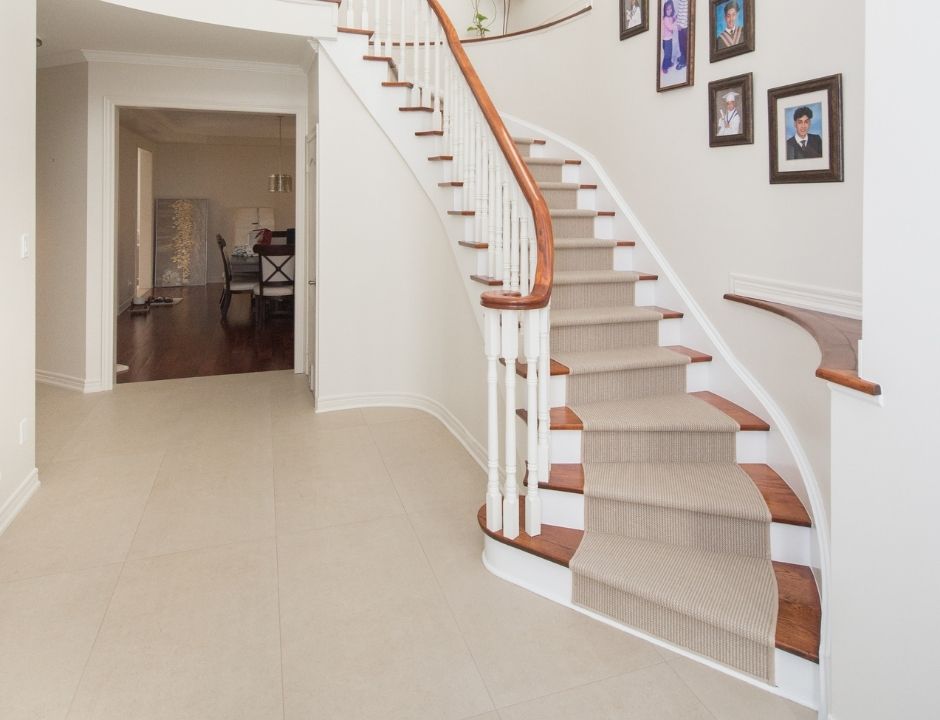
A runner: if you love the warmth of carpet, a runner over new hardwood treads adds grip and softness while still showing off the wood.
Planning it with other work: because new flooring often runs right up to the stairs, many homeowners update both during a larger project. For example, you can plan new floors and stairs with a kitchen renovation so that everything matches from the front door to the kitchen.
Timeline, Dust and Permits
How long it takes: refinishing usually takes two to five days including cure time, recapping takes about a week, and a full replacement takes two to three weeks once materials arrive.
Living at home: if the staircase is the only way to reach the bedrooms, ask how the work will be staged. Some installers finish alternate steps or use fast-curing finishes, so that the stairs stay usable at the end of each day.
Dust and fumes: sanding creates fine dust, so expect the area to be sealed off with plastic. In addition, plan good ventilation while finishes cure, especially if anyone at home is sensitive to odours.
Permits: refinishing and recapping on the existing structure usually do not need a permit. However, replacing a staircase or changing its structure generally does, so check with your city before work begins. Our guide to when a renovation needs a permit explains how permits work in Ontario.
Before You Get Quotes: A Quick Checklist
A little preparation makes quotes far easier to compare, because every contractor will then be pricing the same job.
- ✓Count your steps, and note any pie-shaped, bullnose or landing steps, since these cost more.
- ✓Lift the carpet on one step to see what is underneath, if your stairs are carpeted.
- ✓Decide whether the railing stays, gets refinished or gets replaced, and which material you prefer.
- ✓Bring a flooring sample or a photo, so that the stain can be matched to your floors.
- ✓Ask whether the quote includes HST, posts, spindles, risers and finishing, so nothing is left out.
Once the quotes arrive, our guide to comparing renovation quotes shows how to line them up fairly. You can also see our stair renovation project, including stair renovation before and after photos, on our projects page.
Frequently Asked Questions
How much does a stair renovation cost in the GTA?
As general pricing, refinishing runs about $50 to $90 per step, and recapping starts at around $185 per step. A recap with a full railing upgrade starts near $5,500 for 13 steps, while full replacement commonly costs $10,000 to $25,000 or more.
How much does stair refinishing cost?
Stair refinishing usually costs about $50 to $90 per step in the GTA, or roughly $600 to $1,600 for the treads of a typical flight. Including handrails, posts and spindles raises the total, often to $3,000 to $8,000.
Is it cheaper to refinish or replace stairs?
Refinishing is far cheaper, because it reuses the existing wood. Replacement, on the other hand, only makes sense when the structure is damaged or you want a different staircase design.
What is stair recapping?
Recapping covers each existing step with a new hardwood tread and riser, while the original structure stays in place. In other words, it gives you the look of new stairs without a full rebuild.
How much does it cost to replace carpet with hardwood on stairs?
Converting carpeted stairs to hardwood is usually done by recapping, which starts at around $185 per straight step in solid oak. Pie-shaped and bullnose steps cost more, at about $225 each.
How much does stair railing replacement cost?
Railings often make up 30 to 40% of a full staircase budget. The total depends on the length, the number of posts and the material, while glass and custom metal railings are usually quoted from the design.
How high does a stair railing need to be in Ontario?
Under the current Ontario Building Code, guards inside a home must be at least 900 mm high. Handrails, meanwhile, sit between 865 mm and 1,070 mm above the stair nosings.
How far apart can stair spindles be?
The openings must be small enough that a 100 mm sphere, about 4 inches, cannot pass through. As a result, spindles are typically set close together along the whole run.
Is a glass stair railing allowed inside a house?
Yes, as long as it uses laminated or tempered safety glass and meets the same height and opening rules as any other guard. Because glass railings are custom made, they are usually priced from the design.
How long does a stair renovation take?
Refinishing takes about two to five days including cure time, and recapping takes about a week. A full replacement, however, takes two to three weeks once materials arrive.
Do I need a permit to renovate my stairs?
Refinishing and recapping on the existing structure usually do not need a permit. However, replacing the staircase or changing its structure generally does, so check with your city first.
Ready to Update Your Staircase?
We look at your stairs in person, explain whether refinishing, recapping or replacement makes the most sense, and confirm a fixed stair renovation cost before any work begins.
About Smart Renovations
Smart Renovations is a GTA renovation company founded by Tina Wu, who began her career in kitchen and bathroom cabinetry manufacturing. That hands-on background still shapes how we plan materials and layouts today. Since then, we have completed over 1,000 projects and earned eight service excellence awards in a row, from 2019 to 2026. Today, more than half of our new projects come from referrals.
- Fully licensed and insured, with $5 million in general liability coverage
- WSIB certified, with a licensed electrician on staff
- A 1-year labour warranty on every project
- Offices in Richmond Hill and Woodbridge, serving the Greater Toronto Area
Want to know who is behind the work? Read Tina Wu’s story.