Quick Answer
In the infrared vs traditional sauna choice, a traditional sauna heats the air with a stove and rocks, usually to about 66 to 85°C. You can also add steam by pouring water on the stones. An infrared sauna warms your body more directly at a gentler 49 to 60°C. As a result, infrared is quicker to heat and easier to power, while traditional offers the classic hot, steamy experience.
A home sauna turns an ordinary evening into a small retreat, and on a cold Ontario night that is easy to appreciate. However, the two main types work very differently, and that difference affects the space, the wiring and the budget you will need.
In this guide, we compare infrared vs traditional sauna options side by side, explain where an indoor home sauna fits best, and walk through the power, construction and costs involved. We also cover kits versus custom builds, so you can decide which route suits your home.
Infrared vs Traditional Sauna: Side by Side
Here is how the two types compare on the points that matter most for an indoor installation. On a phone, scroll sideways to see all three columns.
| Feature | Traditional | Infrared |
|---|---|---|
| How it heats | A heater warms the air and a bed of stones | Infrared panels warm the body more directly |
| Typical temperature | About 66 to 85°C (150 to 185°F) | About 49 to 60°C (120 to 140°F) |
| Humidity and steam | Dry until you pour water on the stones | Stays close to normal room humidity |
| Warm-up time | About 30 to 40 minutes | Usable within about 15 minutes |
| Power for 2 people | Often a 4.5 kW heater on a 240V dedicated circuit | Often 1.5 to 1.7 kW on a 120V, 15-amp circuit |
| Construction | Insulated walls and ceiling, foil vapour barrier, wood lining | Usually a pre-built cabin that sits inside a room |
Figures are typical for home units, so always check the exact specifications for the model you choose, since heater sizes and settings vary.
In This Guide
Which Type of Home Sauna Suits You?
Neither type is better for everyone, because the right choice depends on the experience you want, the space you have and how much electrical work your home can take. Fortunately, the quick pointers below usually settle it.
A traditional sauna suits you if…
→ you love intense heat and the burst of steam when water hits the stones.
→ you are building a dedicated room and can run a 240V circuit to it.
→ you do not mind waiting 30 minutes or more for it to heat up.
An infrared sauna suits you if…
→ you prefer a gentler heat that feels comfortable for longer.
→ you want a quicker warm-up for short, frequent sessions.
→ you need a smaller unit that can often run on a standard 120V circuit.
Where a Sauna Fits in Your House
A sauna in your house works best somewhere private, close to a shower and away from busy hallways. With that in mind, these are the most practical indoor spots.
The primary ensuite
Placing the sauna beside the shower makes it easy to cool down and rinse off afterwards. It also fits naturally into a spa-style bathroom design.
A spare room or home gym
Alternatively, a small spare room can hold a sauna plus a bench for cooling off, and it pairs well with a home workout space.
A large walk-in closet or alcove
A compact one or two-person infrared cabin can fit into a generous closet or alcove, provided there is room around it for air and service.
A condo
An in-home sauna in a condo usually needs board approval first. In addition, many condo buildings supply 208V rather than 240V, so a traditional heater must be rated for it, while a small 120V infrared unit is often the simpler choice.
If you are also considering a steam shower, keep in mind that it is a different system entirely. Instead of dry heat, it fills a sealed shower with moist heat.
How a Home Sauna Installation Comes Together
A built-in traditional sauna is a small construction project, while an infrared cabin is closer to installing a large appliance. Either way, a typical home sauna installation follows these stages.
1. Choose the spot and the size
First, measure the room’s width, depth and ceiling height, and think about how many people will use it at once. A lower ceiling heats faster, so built-in saunas often use a dropped ceiling inside a taller room.
2. Check the electrical panel
Before anything is ordered, an electrician confirms whether your panel has room for a new dedicated circuit, since this can change both the budget and the timeline.
3. Frame, insulate and seal
For a traditional sauna, the walls and ceiling are insulated, and a foil vapour barrier goes behind the wood lining to keep heat and moisture out of the framing.
4. Line the room and build the benches
Cedar and hemlock are common choices for the walls and benches, because they handle heat well and stay comfortable to touch.
5. Plan airflow and the door
The intake and exhaust positions depend on the heater and its installation instructions. Meanwhile, sauna doors typically open outward and have no lock, so they can never trap anyone inside.
6. Install the heater and test
Finally, the licensed electrician connects the heater or cabin, the work is inspected under an ESA permit, and the sauna is run through its first heat-up.
Because a sauna adds heat and some moisture to the surrounding room, it also helps to plan good ventilation outside the sauna itself. Our guide to bathroom ventilation explains how to size an exhaust fan, and our moisture control guide covers the habits that keep surrounding walls dry.
Power Requirements for an In-Home Sauna
Electrical work is often the deciding factor in the infrared vs traditional sauna decision, so it is worth understanding early.
Traditional
3 to 9 kW
Typically, home heaters run on 240V and need a dedicated, hardwired circuit, often 30 to 50 amps depending on the heater size.
Infrared
1.5 to 1.7 kW
Many one and two-person cabins run on 120V, although larger units may need 240V, and a dedicated circuit is still usually recommended.
In Ontario, a new circuit must be installed by a licensed electrical contractor under an ESA permit. Moreover, older homes may need a panel upgrade before a large heater can be added, so it pays to have the panel checked first. Our bathroom electrical planning guide explains how dedicated circuits and GFCI protection work.
Pro Tip
If you are already renovating the bathroom or adding other large loads, plan the sauna circuit at the same time. Running one new line while the walls are open costs far less than coming back to do it later.
Kit or Custom: How to Build a Home Sauna
Prefab kits and cabins: a kit arrives as pre-cut panels or a complete cabin, so it installs quickly and costs less. However, it comes in set sizes, which may leave awkward gaps in an irregular room.
Custom builds: if you want to build a home sauna that fits the room exactly, a custom design uses every inch and can match the rest of the house. In return, it takes longer and costs more, since it involves framing, insulation and finish carpentry.
Our view: for a quick, low-disruption option, a quality infrared cabin is hard to beat. On the other hand, if the sauna is the centrepiece of a spa-style ensuite, a custom traditional room usually delivers the look and experience people are hoping for.
Design Ideas for a Spa-Style Indoor Sauna
Whichever side of the infrared vs traditional sauna debate you land on, a few design choices make the space feel far more like a retreat.
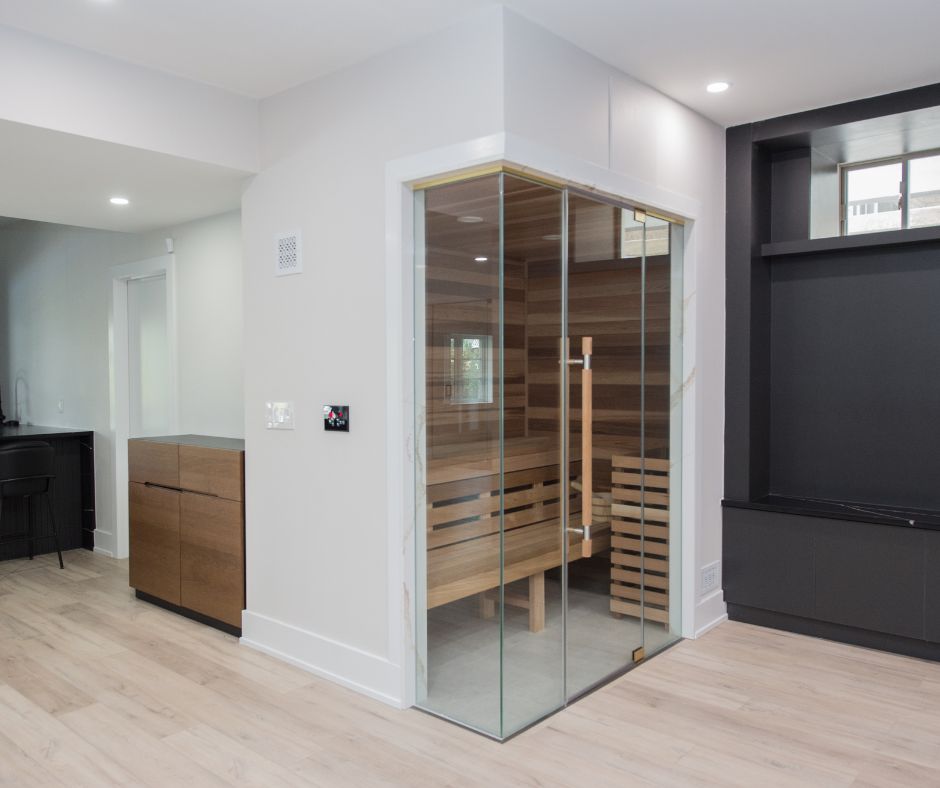
A glass front: a tempered glass door or front panel keeps a small indoor sauna from feeling closed in, and it also lets light from the room reach the benches.
Soft, low lighting: any light inside a sauna must be rated for high heat. Even so, soft, indirect light under the benches or behind a backrest feels far more relaxing than a bright ceiling fixture.
A cool-down plan: place the sauna close to a shower, so that you can rinse off and cool down right away. In addition, a nearby bench and hooks for towels make the whole routine feel effortless.
The right wood tone: light woods such as hemlock feel bright and modern, while cedar brings a warmer colour and a natural scent.
A heater guard: finally, a wooden guard around a traditional heater keeps elbows and knees safely away from hot surfaces.
Looking After Your Sauna
To keep an in-home sauna fresh, leave the door open for a while after each session so the room can dry out. It also helps to sit on a towel, which protects the benches. Every so often, wipe down the benches and floor, and lightly sand any marks on the wood rather than using harsh cleaners.
For a traditional heater, check the stones as often as the manufacturer recommends, since cracked or crumbling stones should be replaced. With an infrared cabin, meanwhile, care is usually as simple as wiping the surfaces and keeping the panels clear.
What Does a Home Sauna Cost?
Home sauna cost depends mainly on the type, the size and whether you choose a kit or a custom room. As a general guide for GTA homeowners, here is what to expect.
| Item | General Pricing |
|---|---|
| Infrared sauna | About $2,000 to $6,000, with many homeowners spending around $3,500 |
| Prefab sauna kit, installed | About $2,300 to $10,500 |
| Custom-built sauna room | About $8,000 to $34,000 |
| Electrical permit in Toronto | About $300 to $600, plus inspection fees |
| Panel upgrade, if needed | About $3,000 to $6,000 |
| Yearly maintenance | About $100 to $300 |
What Does It Cost to Run?
Running costs are easier to estimate than most people expect, because they depend mainly on the heater’s power and how long you use it.
Heater kW × hours of use × your hydro rate per kWh
This gives the most it could cost, since heaters cycle off once the room is hot.
For example, a 4.5 kW traditional heater running at full power for one hour would use at most 4.5 kWh. A 1.6 kW infrared cabin, by contrast, would use at most about 1.6 kWh in the same hour. In practice, both use less once they reach temperature, so check your hydro bill for your actual rate.
Safe Use Basics
First of all, follow the manufacturer’s temperature and time limits, and start with short sessions, often 10 to 15 minutes. In addition, drink water, avoid alcohol before or during use, and never leave children unsupervised. If you are pregnant or have a heart condition, blood pressure concerns or another health condition, talk to your doctor before using a sauna.
Planning an In-Home Sauna With Smart Renovations
We can plan a sauna as part of a larger renovation, so that the electrical, ventilation and finishes all work together from the start. You can see our home sauna project on our projects page.
If your sauna is part of a bigger ensuite update, our team can also handle your spa-style bathroom renovation at the same time. In addition, our permit and timeline guide explains how permits fit into the schedule.
Frequently Asked Questions
What is the difference in an infrared vs traditional sauna?
A traditional sauna heats the air and stones to about 66 to 85°C, and you can add steam with water. An infrared sauna, by contrast, warms the body more directly at about 49 to 60°C and heats up faster.
Can you put a sauna in your house?
Yes, as long as you have a suitable room, enough electrical capacity and a plan for ventilation. In most homes, a spot near the ensuite or in a spare room works best.
How much does a home sauna cost?
As general GTA pricing, an infrared sauna costs about $2,000 to $6,000, and an installed prefab kit costs about $2,300 to $10,500. A custom-built room, however, costs about $8,000 to $34,000, and the exact price depends on your space and layout.
Does a home sauna need a 240V circuit?
A traditional heater usually does, on a dedicated hardwired circuit. Many small infrared cabins, on the other hand, run on 120V, although larger models may also need 240V.
Do I need a permit for a home sauna?
New electrical work in Ontario needs an ESA permit, which a licensed electrical contractor takes out. In addition, building work such as new walls may need a municipal permit, so check with your city.
How long does it take to heat up?
A traditional sauna typically needs about 30 to 40 minutes to reach temperature. An infrared sauna, meanwhile, is usually comfortable within about 15 minutes.
Can you build a home sauna in a condo?
Often, yes, although you will usually need board approval first. Since many condos supply 208V rather than 240V, a small 120V infrared unit is often the easiest option.
Does an indoor sauna need ventilation?
Yes, a traditional sauna needs air intake and exhaust placed according to the heater’s instructions, and the room around any sauna benefits from a good exhaust fan.
What wood is best for a sauna?
Cedar and hemlock are common choices, because they handle heat well and stay comfortable to touch. Your builder will also choose the right wood for benches, where comfort matters most.
How long should a sauna session be?
Many people start with short sessions of about 10 to 15 minutes and follow the manufacturer’s limits. If you have a health condition or are pregnant, however, talk to your doctor first.
Ready to Plan Your Home Sauna?
We help you weigh the infrared vs traditional sauna choice for your space, check your electrical capacity, and confirm a fixed price before any work begins.
About Smart Renovations
Smart Renovations is a GTA renovation company founded by Tina Wu, who began her career in kitchen and bathroom cabinetry manufacturing. That hands-on background still shapes how we plan materials and layouts today. Since then, we have completed over 1,000 projects and earned eight service excellence awards in a row, from 2019 to 2026. Today, more than half of our new projects come from referrals.
- Fully licensed and insured, with $5 million in general liability coverage
- WSIB certified, with a licensed electrician on staff
- A 1-year labour warranty on every project
- Offices in Richmond Hill and Woodbridge, serving the Greater Toronto Area
Want to know who is behind the work? Read Tina Wu’s story.